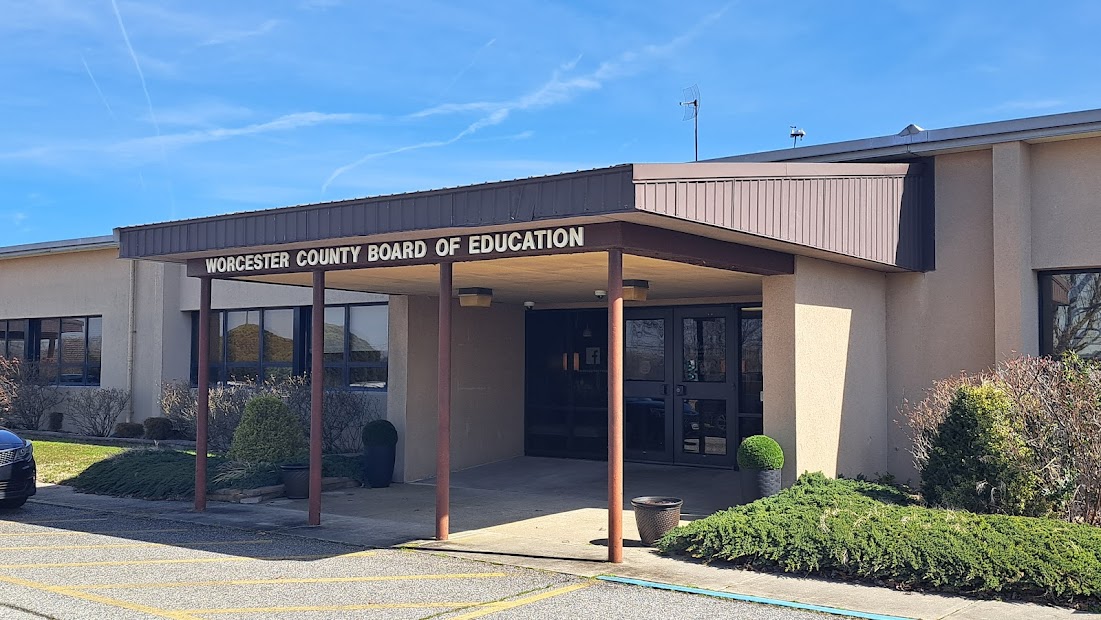
Worcester County Public Schools officials say they have found a way to preserve pre-kindergarten programs at Pocomoke Elementary School despite a nearly $2.8 million reduction in funding approved by the Worcester County Commissioners, but school leaders warn that students across the county will still feel the effects of significant budget cuts.
The Board of Education held a special meeting to adopt a revised Fiscal Year 2027 budget after commissioners voted 4-3 to reduce the school system’s funding request by $2,798,302.
Voting in favor of the reduction were District 1 Commissioner Caryn Abbott, whose district includes much of Pocomoke City, along with Commissioners Jim Bunting, Ted Elder and Chip Bertino. Voting against the reduction were Commissioners Eric Fiori, Joe Mitrecic and District 2 Commissioner Diana Purnell, whose district includes portions of Pocomoke City.
Superintendent Dr. Annette Wallace delivered pointed remarks before the board considered the revised budget, saying the school system was being forced to make difficult decisions because of the commissioners’ action.
“The majority of the county commissioners chose not to fund the education budget that was needed to maintain all of our programs, services, and supports that students deserve,” Wallace said. She told board members that the budget plan before them was not one anyone wanted to make.
“It is not the plan we wanted. It is not the plan our students deserve, but it is the plan required to address the $2.8 million shortfall created by the commissioner’s majority,” Wallace said. Wallace also argued that the funding reduction came despite repeated explanations about the school system’s needs.
“Words of support do not preserve critical student programs. Words of support do not maintain safe school environments. Words of support do not keep opportunities in place for our greatest asset, our children. Budgets do,” she said.
Pocomoke Pre-K Becomes a Flashpoint
One of the most significant local impacts involved funding for pre-kindergarten classrooms at Pocomoke Elementary School.
School officials said approximately $322,950 tied to existing Pre-K positions was not included in the funding approved by commissioners. According to administrators, eliminating those positions would have removed current Pre-K opportunities for Pocomoke students and jeopardized grant funding that would expand Pre-K opportunities elsewhere in the county.
During discussion of the revised budget, Board Member Dr. Jon Andes repeatedly focused on the impact of the vote on Pocomoke.
“Since the commissioner from Pocomoke voted against maintaining the pre-K program at Pocomoke Elementary School, why are we doing it?” Andes asked. Wallace responded that preserving early childhood education was too important to abandon.
“I believe the most important thing that we do in education is our early childhood,” she said.
Rather than eliminate the program, school officials chose to preserve it by delaying the hiring of a chief operating and human relations officer and making additional reductions at the central office level.
“We felt like that was something that we can’t live without right now, no matter what sacrifice we had to make,” Wallace said.
Andes later summarized the decision.
“So as a clarification, what I heard Dr. Wallace just say is we had to go find $322,950 to sustain an existing program for which the commissioner from Pocomoke voted to cut.”
“That is correct,” Wallace replied.
Wallace also emphasized that the funding request was not intended to create new Pre-K classrooms in Pocomoke but to preserve programs already serving local children.
“This would mean if that budget line item was cut, that means those current Pre-K students would no longer be offered that opportunity,” she said during an earlier budget discussion.
RISE Program Eliminated
While the Pre-K program was preserved, another initiative aimed at helping students with behavioral and emotional challenges was eliminated. The proposed elementary RISE program, which carried a cost of approximately $602,000, was removed from the budget. Wallace said the program was designed to address increasing behavioral challenges among younger students.
“Our students are coming to us with more social, emotional needs, more behavioral needs, more dysregulation than ever before,” she said.
The superintendent said the program would have provided support before those challenges became larger problems in middle and high school.
“If they haven’t had the supports that they need to be a successful learner in their classroom environment, this program was going to do that for them,” Wallace said.
Additional Cuts Affect Students
To close the budget gap, the Board of Education approved reductions affecting multiple areas of the school system. Among the cuts are reductions to dual enrollment funding, summer and after-school programs, instructional materials, software purchases, transportation costs, maintenance funding, and technology replacement schedules.
Wallace said the reduction in dual enrollment funding means students will be limited to the minimum number of college credits required under Maryland’s Blueprint for Education.
“The goal of the blueprint is for students to be able to earn an AA degree in high school,” Wallace said. “That means that we will not be able to offer those additional opportunities anymore.”
The district also postponed replacing aging iMac computers used in schools and reduced funding for instructional materials.
“Paper is a really big deal because even though we are digital, we still do a lot of work on paper,” Wallace said. “This means that that will be more of a challenge next year.”
School officials also warned that maintenance projects may have to be delayed because the district lacks reserve funds that could be used to absorb unexpected expenses.
Andes Raises Long-Term Funding Concerns
Andes also questioned the long-term trend of declining education funding as a percentage of Worcester County’s overall budget. During the discussion, Board President Todd Ferrante noted that Worcester County Public Schools once received approximately 54 percent of the county budget, compared to roughly 40 percent today. Andes argued that public discussions often focus on how much money schools request without acknowledging that education’s share of county spending has steadily declined.
“Everybody wants to talk about how much money we need and get and ask for, but we’re getting less and less and less, percentage wise, all the time,” Andes said.
Looking Ahead
The Board of Education approved the revised budget and will submit it to the county commissioners for final approval. Wallace said school leaders spent days reviewing options and believe the adopted plan is the most responsible path forward under the circumstances.
“I don’t feel like there’s a better budget,” Wallace said. “We’re at a point where we’ve cut staff and cut staff over the years, and we just can’t sustain that any longer.”
For Pocomoke families, the immediate result is that existing Pre-K programs at Pocomoke Elementary School will remain in place. However, school leaders say the broader effects of the $2.8 million funding reduction will still be felt through fewer student opportunities, reduced program funding, and continued pressure on school operations across Worcester County.

