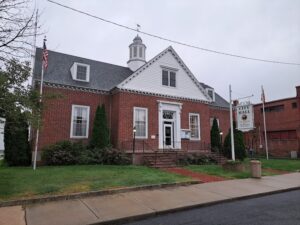
September 28 meeting and work session also examined home-based business licenses, alcohol permit procedures and community grant funding.
Pocomoke City Mayor and Council members approved a new police chief, advanced accessory dwelling unit regulations and discussed several potential changes to city finances, business licensing and infrastructure planning during their September 28, 2026, meeting and subsequent work session.
The meeting included the appointment of Richard Andrew “Andy” McGee as the city’s next chief of police, a proposal to begin taxing automobile dealership vehicle inventories, and a presentation outlining a citywide initiative called Reimagine Pocomoke.
Council members also reviewed community grant applications, discussed a more formal process for special one-day alcohol permits and considered requiring business licenses for certain home-based businesses.
Andy McGee appointed police chief
The Mayor and Council voted to appoint McGee as Pocomoke City’s next chief of police following a recruitment and interview process. Mayor Todd Nock said the council had reached a consensus to move forward with McGee before bringing the appointment to an official vote in open session.
McGee brings approximately 35 years of law enforcement experience, according to the mayor’s remarks.
His law enforcement career began in Pocomoke City in January 1993, when he joined the Pocomoke City Police Department. He served as a patrol officer, worked in crime prevention and community policing, and later served as a patrol supervisor and the department’s second K-9 handler.
McGee subsequently served with the Somerset County Sheriff’s Office before spending more than 21 years with the Worcester County Sheriff’s Office. There, he held leadership responsibilities involving patrol and special operations, eventually serving at the lieutenant level.
In April 2019, McGee became chief of police in Snow Hill, a position he had held for more than seven years at the time of the Pocomoke meeting.
Council members expressed support for the appointment. Councilman Michael Hall praised the selection, while Councilman C.L. Marshall noted that the interview process was lengthy and that all three candidates performed well.
Mayor Nock welcomed McGee back to Pocomoke, describing the appointment as a homecoming.
Council approves accessory dwelling unit ordinance
The council approved Ordinance 2027-O-1 following its second reading and a public hearing. The ordinance amends the city’s zoning code to establish regulations governing accessory dwelling units, commonly referred to as ADUs.
The ordinance follows state legislation enacted in 2025 intended to promote accessory dwelling units on properties where a single-family detached home is the primary residence. The city’s Planning and Zoning Commission reviewed the proposed amendment and recommended changes to align the local code with state law.
The ordinance addresses definitions, development standards, accessory structures and permitted uses in the city’s R-1, R-2 and R-3 residential districts.
No members of the public came forward to comment during the hearing. The council then voted to approve the ordinance.
Accessory dwelling units can provide an additional residential living space on a property with a primary home. The new local regulations establish how such units are addressed under Pocomoke’s zoning code.
City considers taxing automobile dealership inventories
One of the work session’s major financial discussions centered on whether Pocomoke City should begin taxing automobile inventories held by dealerships within city limits.
City Manager Brandy Matthews explained that a 1991 resolution exempted new and used motor vehicles held for sale by automobile dealers from the city’s taxable commercial inventory. Under the current arrangement, qualifying dealership vehicle inventories are exempt from local inventory taxation.
Matthews said the city currently exempts the first $100,000 of assessed commercial inventory and does not collect inventory taxes on qualifying dealer vehicles. She also noted that some dealerships have been reporting vehicle inventory together with other commercial inventory, making it difficult for the Finance Department to distinguish between the categories.
The current commercial inventory tax rate is $2 per $100 of assessed value. Matthews illustrated the potential revenue at stake by explaining that a dealership with $5 million in assessed vehicle inventory could generate $100,000 annually at that rate if the entire inventory were taxable.
Staff proposed establishing a separate rate of $1.50 per $100 of assessed value for new and used vehicles held by dealers for sale.
Matthews also compared Pocomoke’s approach with other municipalities. According to her presentation, Salisbury taxes 45% of applicable vehicle inventory, Fruitland taxes 65%, and Pittsville taxes 75%.
Council members discussed how vehicle inventory is reported on state business personal property forms and how the city might distinguish vehicle inventory from other commercial inventory, such as parts.
Mayor Nock recommended that staff draft legislation for council consideration at a future work session. The discussion did not result in the adoption of a new tax rate.
City works toward a formal alcohol permit process
Council members discussed creating a municipal approval process for special one-day alcohol permits, including a proposed application and a potential administrative fee.
The discussion followed concerns about the amount of work required of city staff when event organizers submit requests close to their event dates. Mayor Nock said the city needed a more consistent process that would allow staff to review applications and obtain the necessary council approvals before forwarding documentation to Worcester County.
The proposed process would complement the county’s alcohol permitting requirements rather than replace them.
Three upcoming events were reviewed:
- Tull wedding reception: November 13, 2026, from 5 p.m. to 11 p.m.
- Wallops Christmas party: November 20, 2026, from 5 p.m. to 10 p.m.
- Black Ball Gala: December 5, 2026, from 4 p.m. to 10 p.m.
All three events are scheduled to take place at the Pocomoke City Volunteer Fire Company. Council members reached a consensus to proceed with the three permit applications.
Separately, staff presented a proposed Alcohol Service Approval Application modeled on the county’s existing process. The form identifies different types of alcohol service, including alcohol provided without a direct charge, alcohol included with admission, beer, distilled spirits, sales, and tastings.
Matthews said the county charges a $100 permit fee and suggested the city consider charging approximately half that amount to account for administrative work.
However, Mayor Nock questioned whether a fee applied only to special one-day permits would be fair to organizations that regularly host events. He asked staff to reconsider the fee structure and return with a proposal.
No final fee or formal approval of the proposed city application was established during the work session.
Council discusses licenses for home-based businesses
Councilman C.L. Marshall introduced a discussion about whether Pocomoke should require municipal business licenses for businesses operating from residential properties.
Marshall said he had spoken with several brick-and-mortar businesses that expressed concerns about home-based businesses operating without the same municipal licensing requirements.
Under the approach he proposed, income-producing business activities within city limits would generally be required to register for a municipal business license. He suggested that state business registration and annual filing requirements could help identify businesses that should obtain a local license.
Examples discussed included online sales, consulting, craft sales, remote professional services, childcare, salons, food preparation and repair services.
Marshall distinguished between low-impact businesses that operate entirely indoors without customer visits, employees or signage and businesses that generate more traffic or have customers visiting residential properties.
The latter category could require additional review under home-occupation rules or a conditional-use permit, depending on the circumstances.
Marshall said the proposed licensing system should be straightforward, with an online application, printable forms and the ability to apply in person at City Hall. He also emphasized that a municipal license would not replace state licensing, trader’s licenses or applicable professional and occupational requirements.
The discussion covered potential benefits for planning, neighborhood compatibility, emergency response and maintaining a more complete picture of businesses operating within the city.
Council members directed staff to draft legislation for further consideration. The proposal was not adopted during the meeting.
Community Impact Grant program considers two more applications
Community Outreach Coordinator Amanda Russell presented two additional applications under the city’s Community Impact Grant program.
At the time of the presentation, the city had received 15 applications, with eight recommended for funding. Total funding requested across those applications was $132,144.85, while recommended awards totaled $68,496.85. The program had $100,000 available, leaving $31,503.15 after the recommended awards.
Six projects had previously been selected for funding at the August 24 meeting.
New Macedonia Baptist Church
The church requested $10,000 for its Baskets of Love Food Pantry project. Staff recommended the full $10,000 award.
The project is intended to provide nutritious food and essential household items to individuals and families experiencing food insecurity. Planned expenses include food purchases, pantry supplies, equipment, operations, community outreach and emergency food reserves.
The application estimated that the pantry could serve approximately 900 to 1,500 households annually, depending on donations, partnerships and local demand.
Mayor Nock expressed support for the proposal, particularly the plan to track pantry visits and other service data. He said that information could help the city better understand local needs and identify opportunities to respond.
Pocomoke Boat Docking Association
The association requested $5,000 for its Pocomoke Boat Docking Challenge, with staff recommending a $3,500 reimbursement for eligible expenses associated with the August 2026 event.
The application identified the event’s role in attracting visitors, supporting downtown businesses and providing scholarships for Pocomoke High School graduates pursuing education and skilled trades. It also described a proposed scholarship opportunity for a local young adult pursuing a commercial driver’s license.
The application reported total expenses of $33,159.77, income of $32,000 and $2,000 in scholarships.
Council members questioned the reported scholarship amount and sought clarification about other event expenses, payments to participating boat captains and the overall financial picture. Mayor Nock also raised questions about the city’s support for the event and whether the Boat Docking Challenge should become a city event given the assistance provided.
Russell said she could only rely on the budget information submitted with the application. Council members agreed to hold the reimbursement recommendation until additional documentation and clarification could be provided, including an opportunity for association representative Mike Shannon to answer questions.
No final grant award was made for the Boat Docking Challenge during this discussion.
Reimagine Pocomoke outlines a citywide improvement strategy
Senior Planner Benjamin Zito presented Reimagine Pocomoke, an initiative developed in coordination with Mayor Nock to organize community ideas into a pipeline of infrastructure, beautification and public-space improvements.
The proposal is intended to identify projects, develop concepts, estimate costs and prepare improvements for consideration as funding becomes available.
Zito said the initiative would cover the entire city rather than focus exclusively on downtown. Potential projects could include landscaping, sidewalk repairs, improved lighting, gateway enhancements, park improvements and maintenance or repair of existing public infrastructure.
The Beautification Commission and residents would help generate and prioritize ideas, while planning staff would develop project concepts and assess consistency with the city’s zoning code and comprehensive plan. Capital improvements staff would evaluate feasibility, engineering requirements and cost estimates. The Mayor and Council would retain responsibility for policy direction, budgets and major project decisions.
Mayor Nock encouraged staff to begin developing projects before funding is secured, arguing that advance planning would help the city move more quickly when money becomes available.
He suggested budgeting between $25,000 and $50,000 in the next budget cycle for Reimagine Pocomoke projects. That figure was presented as a recommendation for future budget consideration, not an approved appropriation.
Potential funding sources discussed included state grants, city funding and public-private partnerships. Council members also raised the possibility of an adopt-a-block program and emphasized the importance of selecting improvements the city could maintain over time.
Zito outlined an initial timeline that would begin with organizing the commission’s work and gathering community input during the first 90 days. The following three to six months would focus on identifying feasible projects and pursuing early improvements, with a six-to-12-month phase devoted to presenting projects to council and developing a funding roadmap.
The presentation concluded with a request for council support to continue developing the initiative, review the Beautification Commission’s operating structure, establish citywide project inventories and prioritization criteria, and prepare a first-year action plan.
The presentation received positive responses from council members. The discussion did not include a formal budget appropriation or approval of individual construction projects.
During closing remarks, Mayor Nock credited a photograph of Willow Street shared by local resident Chip Choquette (Editor’s Note: Yes, me…) in August as an inspiration for the initiative, saying it prompted him to think about how Pocomoke could be improved and reimagined.
Other business and council comments
During approval of the bill list, Councilman Michael Hall noted that the city was preparing to approve $8,862 for the Great Pocomoke Fair related to horse-race winners. He said he wanted residents to be aware of the city’s support for the fair.
Council members also praised the recent Fourth Friday events and the Hometown Throwdown, thanking city staff for their work organizing community activities. Mayor Nock expressed interest in continuing Hometown Throwdown as a recurring citywide event.
The work session concluded after the Reimagine Pocomoke presentation and a brief exchange about a property matter that council members agreed not to discuss at that time.

